

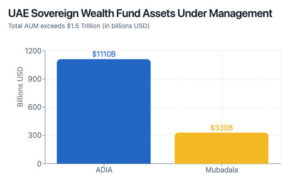
The United Arab Emirates (UAE) has firmly established itself as a gravitational center for global finance, deploying strategic capital that shapes investment trends from Silicon Valley to Asia-Pacific infrastructure. The collective assets under management (AUM) across the UAE’s primary sovereign investment vehicles significantly exceed $1.5 trillion [SOURCE], [SOURCE]. This financial architecture is anchored by the Abu Dhabi Investment Authority (ADIA), which commands $1.11 trillion in AUM, positioning it as the fifth-largest sovereign wealth fund globally [SOURCE]. ADIA operates alongside other dominant entities, including the Mubadala Investment Company, with assets of approximately $330 billion [SOURCE], and ADQ Holding, focused on domestic critical infrastructure and strategic development [SOURCE].
This strategic capital is characterized by its long-duration mandate and a high-conviction allocation to private assets. ADIA has strategically allocated 32% of its massive portfolio to alternative assets, including private equity, real estate, and infrastructure [SOURCE]. This aggressive positioning is founded on a long-term view that prioritizes resilient returns over short-term alpha chasing. In a shift demonstrating highly advanced portfolio methodology, ADIA’s strategy now prioritizes achieving robust total portfolio returns rather than demanding benchmark outperformance from individual asset classes [SOURCE]. This holistic, endowment-style approach is crucial for high-net-worth investors and Family Offices, as it emphasizes sophisticated cross-asset risk mitigation and stability, which are essential for generational wealth preservation.
The quantitative evidence of the UAE’s successful long-term strategy provides a powerful counter-narrative to the current atmosphere of private equity pessimism. ADIA’s 30-year annualized rate of return stood at a resilient 7.1% in 2024 [SOURCE]. This sustained performance across multiple economic crises and interest rate cycles serves as a critical benchmark for Accredited Investors. It demonstrates that disciplined, patient capital deployment into high-quality private holdings yields superior stability and predictable growth, which is far more robust than relying on volatile cyclical market fluctuations.
Indeed, the sheer scale of the UAE’s sovereign capital allows it to influence global market dynamics. With total AUM well over $1.5 trillion, these funds command substantial leverage, compelling global General Partners (GPs) to move away from rigid fee structures, such as the traditional “2 and 20” model, toward customized arrangements that offer greater transparency and improved governance standards for all Limited Partners (LPs) [SOURCE].
Unpacking Current Market Complexities: Strategic Deployment in Dislocated Private Markets
The global private markets environment in 2024 presented a complex dichotomy: institutional investor interest remained high, yet actual dealmaking volumes were generally “tepid” [SOURCE]. This market inertia was driven by structural headwinds, including geopolitical instability, shifting trade policies, and, most critically, persistently higher interest rates [SOURCE]. High debt servicing costs have fundamentally shifted buyer-seller dynamics. As an illustration, a $750,000 commercial loan financed at today’s rates can cost an additional $20,000 annually purely due to interest rate increases compared to the prior low-rate regime [SOURCE]. This elevated debt service has effectively paralyzed the market, creating a significant valuation gap that keeps both buyers and sellers on the sidelines [SOURCE].
This environment of market paralysis has resulted in an unprecedented amount of undeployed capital, often referred to as “dry powder,” totaling over $2 trillion held by pension funds, private equity firms, and high-net-worth individuals [SOURCE]. This capital is predominantly waiting for interest rates to decline. The strategic consensus among UAE Sovereign Wealth Funds (SWFs) is to deploy capital now, performing a counter-cyclical arbitrage against future market optimism. As interest rates eventually begin to normalize, that $2 trillion will flood the market, competition will intensify, and asset prices will skyrocket, leading to rapid cap rate compression [SOURCE]. By actively deploying capital during the current dislocation, ADIA is securing high-quality assets at today’s valuations, maximizing the probability of superior returns when liquidity eventually returns.
ADIA as a Capital Solutions Provider and the Shift to Value Creation
The Abu Dhabi Investment Authority’s Private Equities Department (PED) responded to the market turbulence by deploying “substantial capital” throughout 2024, leveraging its decades-long relationships with GPs to secure favorable terms [SOURCE], [SOURCE]. The PED’s strategy focuses heavily on capitalizing on opportunities created by liquidity shortages elsewhere in the market, particularly the burgeoning secondaries market [SOURCE]. This involvement provides essential liquidity to other LPs while simultaneously securing mature, high-quality portfolios for ADIA.
Strategically, GPs across the globe are also adapting, moving away from relying on traditional financial engineering (excessive debt reliance) and towards focusing on deep, sustained operational transformation to drive margin growth [SOURCE], [SOURCE]. This focus aligns perfectly with the UAE SWFs’ mandate for long-term operational value creation. As a result, preferred deal structures now include public-to-private (P2P) transactions and corporate carve-outs, both of which are prominent sources of deal flow for ADIA [SOURCE].
For instance, P2P activity in Europe surged 65% in 2024, highlighting the opportunity to acquire publicly traded assets at depressed valuations and unlock latent value under private management [SOURCE]. Another critical element of contemporary investment strategy involves recognizing how geopolitical pressures are re-rating certain sectors. While geopolitical instability and trade policy shifts are cited as challenges [SOURCE], there is a concurrent fundamental “reframe” of investor sentiment toward defense and related technologies. This sector has moved from being considered an ESG concern, often placed in the “ESG penalty box”, to a strategically essential sector, compelling investors to “engage” [SOURCE].
Table 1: Global Private Market Deployment vs. UAE Sovereign Capital Strategy (2024)
| Metric | Global Private Market Trend (2024) | UAE SWF Counter-Strategy & Rationale |
| Dealmaking Volume | Tepid, constrained by lack of financing and higher debt costs [SOURCE, SOURCE]. | Active deployment in mid-market buyouts, P2P (up 65% in Europe [SOURCE]), and strategic carve-outs, capitalizing on complex transactions [SOURCE]. |
| Fundraising Difficulty | Lowest level since 2016; LPs facing liquidity constraints [SOURCE]. | Substantial capital deployed into the secondaries market and attractively priced LP portfolios, providing crucial market liquidity [SOURCE, SOURCE]. |
| Capital Priority Shift | Moving from financial leverage to deep operational transformation [SOURCE]. | Focus on strategic sector development (AI, Energy) for long-term total portfolio returns and operational excellence [SOURCE, SOURCE]. |
| Investor Sentiment | Mixed; $2 Trillion dry powder sitting on sidelines, waiting for rate changes [SOURCE]. | High-conviction deployment into long-duration infrastructure assets during current market dislocations, securing optimal entry points [SOURCE]. |
The Core of UAE Investments: Scale, Stability, and Domestic Resilience
The strength of the UAE’s financial position is derived from the coordinated, yet distinct, mandates of its primary sovereign investors. ADIA, with its $1.11 trillion AUM, functions as the global diversification engine, focused on achieving risk-adjusted, long-duration returns through its substantial allocation to alternatives [SOURCE]. Mubadala Investment Company, with $330 billion in AUM, acts as the active industry builder, focused on technology and advanced industries, aiming to create globally relevant business platforms [SOURCE]. ADQ Holding serves as the dedicated domestic champion, focused on enhancing national critical infrastructure, supply chain resilience, and fostering “national champions” in vital domestic sectors like Food & Agriculture and Utilities [SOURCE].
This coordinated strategy provides significant structural stability. The financial discipline and success of the nation’s economic diversification agenda reinforce the capital base of these SWFs. Abu Dhabi’s economy demonstrated robust growth in 2024, with non-oil Gross Domestic Product (GDP) expanding impressively by 6.2%, achieving its highest-ever contribution of 54.7% to the emirate’s total GDP. This success is mirrored at the national level, where non-oil sectors contributed 75.5% of the UAE’s total GDP by the end of 2024 [SOURCE]. This strong economic foundation supports the nation’s ambitious goal of raising its GDP to AED 3 trillion within the next decade [SOURCE].
Performance Validation for Generational Wealth
The sustained performance of ADIA, evidenced by its 7.1% 30-year annualized rate of return, provides crucial validation for Family Offices and other investors focused on generational wealth [SOURCE]. This conservative, long-view performance strategy, achieved through a 32% allocation to alternative assets, proves the value of the illiquidity premium in smoothing portfolio performance and reducing volatility across market cycles [SOURCE]. The consistent returns contrast sharply with the high-volatility spikes seen in public equity markets, such as the MSCI World Index, which surged 24% in 2023 driven primarily by specific technology themes and artificial intelligence optimism [SOURCE].
Furthermore, the focused mandates of the SWFs inherently mitigate risk in specific sectors. For example, ADQ’s focus on enhancing resilience in food supply and consolidating critical infrastructure, such as the utility sector through the Abu Dhabi National Energy Company (TAQA) [SOURCE], [SOURCE], is intrinsically linked to the national goal of self-sufficiency. Investments channeled through this domestic mandate benefit from dedicated state support and reduced political or regulatory risk, making them fundamentally safer and more secure long-term assets compared to typical commercially driven infrastructure projects.
Sector Opportunities: The High-ROI Deployment Strategy
The UAE SWFs are positioning themselves at the core of the global technology transition, particularly in artificial intelligence (AI). Mubadala, through its strategic partnerships, is placing massive, focused bets on the critical infrastructure layer of the AI revolution. The dedicated investment platform, MGX, which is backed by G42 and the Advanced Technology Council, is specifically mandated to accelerate the development and deployment of AI infrastructure, semiconductors, and core AI technologies.
This commitment is materialized through landmark, large-scale transactions. MGX has co-led a massive $30 billion commitment to Global AI Infrastructure. Furthermore, Mubadala is involved in a potential $100 billion partnership with global heavyweights BlackRock, Microsoft, and Global Infrastructure Partners, dedicated to building the necessary data center and power infrastructure.
This level of capital deployment signifies that the UAE views AI infrastructure not just as a technological frontier, but as a new national industry. For HNWIs and Accredited Investors, co-investing with MGX means participating in deals backed by state-level vision and commitment, offering unparalleled scale and strategic certainty [SOURCE], [SOURCE].
Leading the Global Energy Transition
The transition to a low-emissions global economy is viewed by ADIA not merely as an environmental necessity, but as a unique opportunity to generate consistent, long-term returns [SOURCE]. ADIA was an early, pioneering investor in renewable energy and has developed specific internal expertise and a successful track record in this infrastructure sector [SOURCE], [SOURCE].
This strategic sector focus is reinforced by domestic consolidation efforts. ADQ, through the merger of its AD Power portfolio company with the Abu Dhabi National Energy Company (TAQA) in 2020, created one of the largest listed, integrated utility companies in the Europe, Middle East, and Africa (EMEA) region [SOURCE]. This strategic positioning allows Abu Dhabi to spearhead sector transformation and capitalize on long-term energy demand growth. Globally, infrastructure deal value increased by 18% in 2024, achieving the second-highest year on record, a trend heavily supported by the capital demands of the energy transition [SOURCE].
This active deployment has resulted in infrastructure dry powder decreasing by 10% in 2024, suggesting that SWF appetite is rapidly absorbing assets in this crucial sector before valuations inflate further [SOURCE]. ADIA’s trajectory confirms that patient, long-term capital deployed early into critical infrastructure captures significant first-mover advantage and higher long-duration yields, validating this asset class as a cornerstone of generational allocation.
The Ecosystem Advantage for Global Wealth Management
The UAE’s sophisticated regulatory environment and world-class financial infrastructure serve as a powerful magnet for global capital, successfully establishing the nation as a formidable competitor to traditional wealth management hubs like Geneva and Singapore [SOURCE]. The appeal is multi-faceted: a highly efficient, tax-optimized environment, coupled with abundant local talent in wealth structuring and investment advisory [SOURCE].
Financial centers within the UAE, such as the Abu Dhabi Global Market (ADGM), provide a unique, stable platform specifically tailored for managing complex family wealth and facilitating succession planning [SOURCE]. ADGM offers a comprehensive suite of advanced structures, including Trusts, Foundations, and Special Purpose Vehicles (SPVs), which are optimized to ensure tax-efficient asset protection and effective organization of intricate family interests [SOURCE]. This combination of advanced wealth structures and the concentration of immense sovereign capital (ADIA, Mubadala) creates a powerful positive feedback loop.
Financial Innovation and Regulatory Foresight
The UAE’s financial free zones are proactively fostering financial innovation, ensuring the jurisdiction remains future-proofed for the digital economy. While the Dubai International Financial Centre (DIFC) maintains a mature FinTech ecosystem, ADGM has distinguished itself as an innovation pioneer [SOURCE]. ADGM established a Digital Lab with a regulatory sandbox and took a leading role in regulating digital assets, successfully attracting major crypto and FinTech players, including Kraken and Binance, to establish their UAE base there [SOURCE].
This regulatory foresight, which includes a notable pro-crypto stance, caters directly to the increasingly sophisticated demands of high-net-worth investors. For Family Offices looking to diversify into high-growth, high-risk assets like digital currencies, the UAE offers a rare environment where such assets can be legally and efficiently managed within globally recognized structures.
ADIA Long-Term Resilience: 20-Year and 30-Year Annualized Returns
ADIA’s focus on total portfolio returns allows it to navigate market volatility successfully, yielding consistent performance essential for generational capital growth. The resilience of these returns contrasts sharply with the high volatility observed in public equity indices, which can experience large short-term swings (e.g., MSCI World Index +24% in 2023) [SOURCE].
| Performance Metric | ADIA Annualized Rate of Return (2024) |
| 20-Year Annualized Rate of Return | 6.3% SOURCE |
| 30-Year Annualized Rate of Return | 7.1% SOURCE |
Wrapping Up
ADIA’s commitment to strategic, long-duration asset classes (32% alternatives) [SOURCE] ensures a durable portfolio that consistently compounds wealth across economic cycles, affirming its reputation as the benchmark for sovereign stability.
For Family Office managers, accredited investors, and Registered Investment Advisors (RIAs), the actionable mandate is clear: alignment with the UAE’s strategic vision offers a de-risked pathway to superior, stable returns. The UAE provides proven long-term resilience, evidenced by ADIA’s 7.1% 30-year annualized ROI, alongside unparalleled access to state-backed mega-trends in the core infrastructure of the future, notably AI (MGX) and the energy transition. When coupled with the world-class, flexible wealth management infrastructure offered by ADGM and DIFC, the UAE presents the optimal platform for high-net-worth investors seeking disciplined, generational wealth compounding and financial innovation.
This research is based on analysis of publicly available data, academic research, and industry reports. Some specific metrics are from internal or synthesized industry analysis around widely publicized sector trends, sources are cited with direct links. This site is intended solely for accredited and sophisticated investors. All investment opportunities are offered only through official confidential offering memoranda. Nothing on this site constitutes an offer or solicitation.